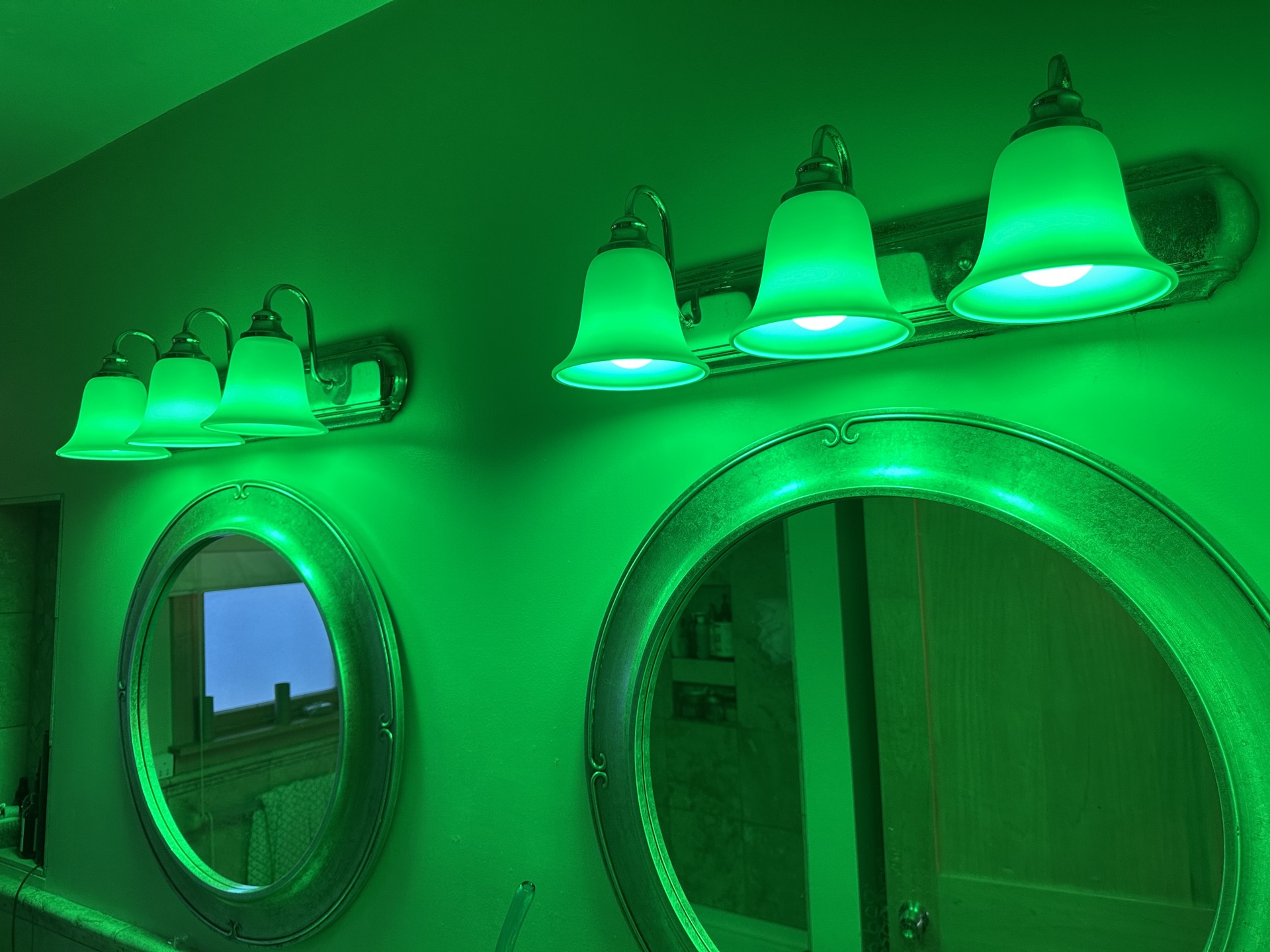
There's a specific flavor of humility only a smart home can deliver, and for me it showed up at the bathroom vanity.
I'd been wanting to play with Matter, so I picked up six new bulbs for the front bath — three over each sink. On paper it was everything home automation promises. I could control them individually, in groups of three as "left sink" and "right sink," or all together as "vanity." And — I was sure I'd done this right — I'd preserved every affordance the household already knew. The same wall switches we'd been flipping for years were still right there. Worst case, I told myself, you flip the switch and the lights come on. Belt and suspenders.
That held up beautifully until the bulbs sat powered off just long enough to drop their pairing. Now the wall switch still "works" — technically. Flip it, and you're greeted by six unpaired bulbs cycling through a rainbow disco strobe, like a tiny rave nobody RSVP'd to. You walk in to brush your teeth and get a nightclub.
That's the whole problem in one anecdote. The technology worked. The household did not.
A labor of love, with lumps
Home automation in 2026 is still a labor of love — a bit like 3D printing was in the olden days. When it works, it's genuinely magic. I say "Alexa, bedtime," and the lights go out, the TV powers down, and the door locks itself. The first time the whole sequence fires in order, you feel like you live in the future.
And when it doesn't work, it's pure folly — chaos and frustration in equal measure. Did the Raspberry Pi crash? Did the link from Alexa to Home Assistant quietly fall over? Did an HA upgrade — one of the roughly infinite HA upgrades — just break everything?
When it's only me on the hook, that's a debugging session and, eventually, a war story. The trouble is that it's never only me.
You have to make peace, going in, with the fact that you're going to take some lumps. From yourself, sure — but mostly from the people you live with. So the real question, before any of the fun stuff, is the one every hobby eventually forces: is the juice worth the squeeze?
For me, it is. I'll happily pay the tax: the constant HA updates, the integrations that move out from under you, the multiple mesh networks I apparently run now. Because here's the thing nobody tells you at the start — the technology is the easy part. Fiddly, yes. Time-consuming, absolutely. But tractable. You can read the docs, watch the logs, roll back the bad upgrade.
The hard part doesn't live in the logs. It lives in the kitchen, and the office, and the front bath.
Name the hard part
Hobbyists already have a name for it: the Wife Acceptance Factor. Happy wife, happy life. I know — it's dated, it's gender-biased, and it's due for a rebrand. So let's call it the Household Acceptance Factor: HAF. The test subjects. The involuntary users — the people who never opted into your project and have to live in it anyway.
That last phrase is the one that matters. Involuntary users. Nobody else in your house signed up to be a beta tester. They didn't read the changelog. They don't care that it's a known issue with a fix landing in the next release. They care that the light comes on.
The one rule: fail gracefully
Which brings me to the single most useful design rule I know — the one the vanity violated:
Wherever possible, design systems that fail gracefully.
The good version is addition. You put in smart bulbs or a smart switch, and it works out because the switch is still there. Control it by app, control it by voice, control it however you like — but if all of that falls over, there's still the same piece of plastic on the wall that's worked since the house was built. You added a capability without subtracting one.
The bad version is subtraction. If there used to be a switch on the wall for the dining room light, and now there isn't — now it's an app, or a phrase, or nothing — you've already lost. Not "you're at risk of losing." Lost. The first time the Wi-Fi hiccups during dinner, you are personally the reason the dining room is dark, and there's no switch to bail you out.
And — as the vanity taught me — preserving the affordance isn't even enough if you don't also protect its failure mode. I kept the switches. I just never imagined a state where flipping one would be worse than doing nothing. Graceful degradation isn't "the old thing still exists." It's "when the new thing fails, the old thing still does what people expect." A wall switch that summons a disco is not a fallback. It's a second bug wearing the costume of the thing people trusted.
Empathy is the engineering
This is where empathy stops being a nicety and becomes part of the spec. The people you live with are not nerds. They might genuinely enjoy a convenience or two — but nobody, ever, enjoys it when technology fails, or when an affordance they relied on simply disappears.
You'll know you've crossed the line the first time you hear some version of: "Dad, could you turn on my mirror, please? Alexa isn't working." That sentence is a bug report, a one-star review, and a referendum on your entire hobby, all at once. The mirror used to just turn on. You're the reason it's a negotiation now.
And even when you're sure you've got all of this covered — don't get cocky. There's always something. I did the homework on that vanity. I kept the switches. I felt clever. The failure mode I never saw coming was six unpaired bulbs throwing a rave. The lesson isn't "try harder." It's "assume you missed one, and go ask what happens when you did."
It's just change management with better lighting
If all of this sounds familiar from somewhere other than the living room, it should. This is change management, at one-house scale, with a much faster feedback loop.
The best technology in the world — genuinely miraculous on a good day — will still fail in production if it doesn't degrade gracefully and if it isn't rolled out with proper change management. The home just makes the lesson vivid, because the affected users eat dinner with you. "Oh, didn't I mention? There's no key to the back door anymore — you have to use your phone now" is not how you open that conversation in a house, and it's not how you open it in an enterprise either. Removing an affordance people depend on, with no fallback and no warning, is the same unforced error whether the blast radius is a family of three or thirty thousand users. The house is just the version where you get the performance review at breakfast.
The founding principle
So if there's a first-order principle under everything else I'll write in this section — and I think there is — this is it. The technology is the easy part. Predict your failure modes. Preserve the affordances and protect them when they break. And treat the people you live with as the involuntary users they are, because they're doing you the considerable favor of living inside your hobby.
Happy household, happy life. The juice is worth the squeeze — but only if you keep your eye on who's actually drinking it.
Now if you'll excuse me, I have six bulbs to re-pair before someone needs to brush their teeth.